
How Do You Move from Karma to Dharma?
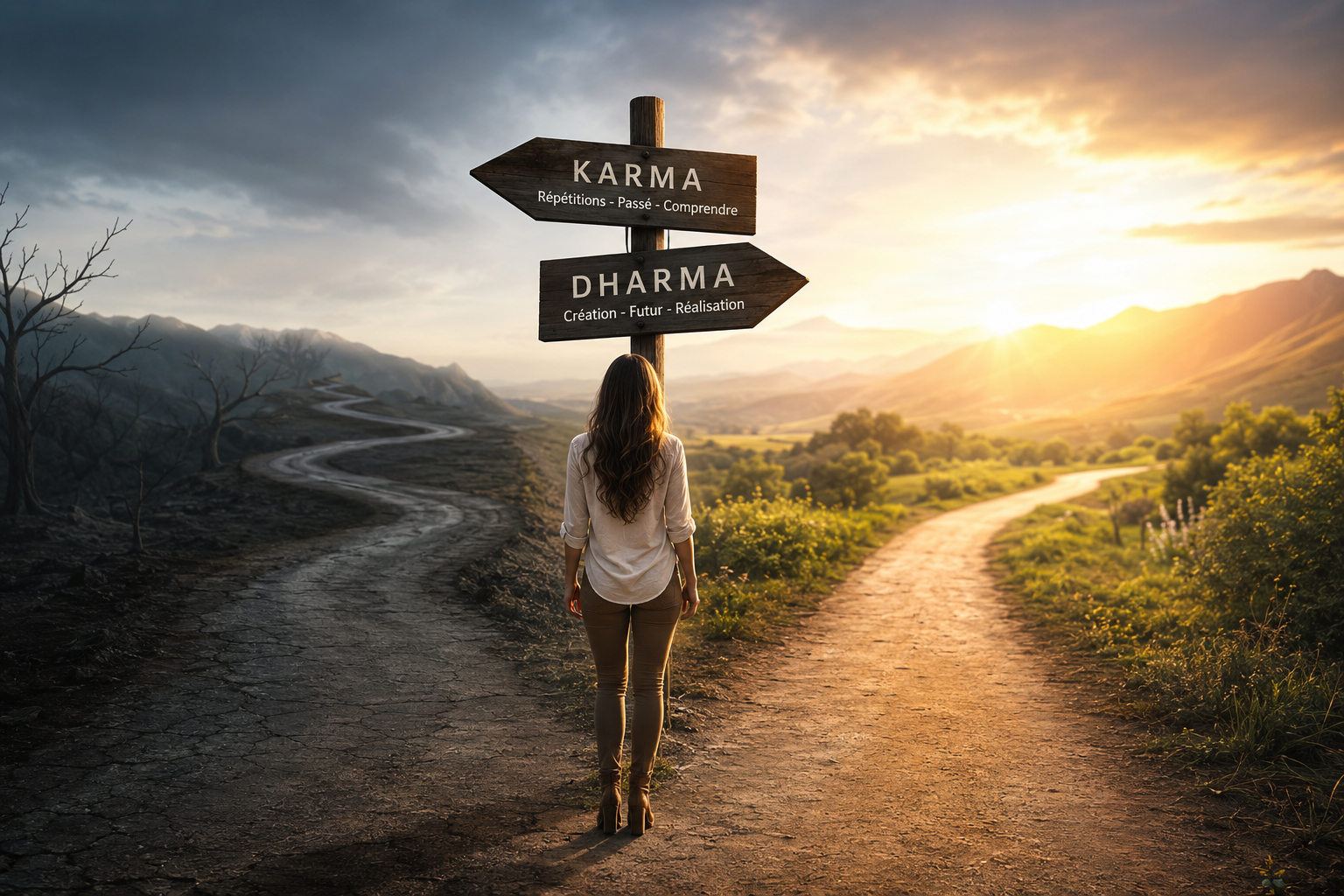
How Do You Move from Karma to Dharma? What if your life was not only about healing your past... but above all about creating your future?
For years, we try to understand what is holding us back.
Why do I keep experiencing the same situations?
Why do the same relationships keep returning to my life?
Why do I feel as though I am going in circles despite all the inner work I have already done?
We read books.
We attend courses.
We go to therapy.
We explore our family history.
We try to understand our wounds, our past lives, our transgenerational patterns, and our unconscious memories.
Then, one day, a question arises.
How much longer am I going to keep working on myself?
This question is often the sign that a new stage is trying to emerge.
Perhaps the time has come to move from karma... to dharma.
Karma: The Past Repeating Itself
Contrary to popular belief, karma is not a punishment.
It is neither a debt to be paid nor a predetermined fate.
In my work as a Karma and Dharma Reader, I view karma as a genuine inner language.
It reveals our patterns, repetitive behaviors, fears, wounds, talents, and the resources that already exist within us.
But it is essential to understand one fundamental truth:
Karma is the past that needs to be released.
A past that may have been lived, inherited, forgotten, or remain completely unconscious.
And yet, it continues to shape our lives.
Karma manifests itself in every area of our existence:
our relationships;
our family;
our work;
our finances;
our health;
our place in society;
our ability to create.
Every repetition carries information.
Every difficulty tells us something about our inner functioning.
Understanding your karma means learning to read this invisible map that influences your choices and the way you experience life.
Why Do Some People Remain Stuck in Their Karma?
Today, many people devote a large part of their lives to personal development.
They search.
They analyze.
They heal.
They cleanse.
They understand.
Yet despite all this, they sometimes continue to feel stuck.
Why?
Because all of their energy remains focused on the past.
Inner work is essential.
It helps restore coherence, soothe certain wounds, and gradually free us from repetitive patterns.
But there is a limit.
At some point, continuing to search without creating becomes a new karmic pattern in itself.
We end up working on ourselves... instead of fully living our lives.
Karma Prepares the Ground
Karma is a stage.
It helps us know ourselves better.
It allows us to find our rightful place.
To understand why certain experiences keep returning.
To identify the fears that still influence our decisions.
To recognize our family loyalties, unconscious memories, and the structures that shape our lives.
Little by little, the repetitions begin to fade.
Relationships become more peaceful.
Work regains meaning.
Life becomes more stable.
This period often corresponds to what I call a karma of peace.
Everything finally seems to fall into balance.
And yet...
It is still not dharma.
Karma and Dharma Always Coexist
There is one fundamental point that is often overlooked:
Karma and dharma never exclude one another. They coexist at all times.
Even as we move toward our dharma, certain karmic areas continue to exist, evolve, or be released.
Likewise, even during highly karmic periods, part of our dharma is already present, quietly guiding us from within.
We do not move linearly from one state to another.
Instead, we gradually learn to live in balance between the two.
Karma slowly dissolves.
Dharma gradually awakens.
And both coexist—sometimes subtly, sometimes very visibly.
Dharma: A Life We Have Never Lived Before
Dharma represents an entirely different stage.
It is no longer about healing.
It is about creating.
Creating a new way of loving.
Creating a new professional activity.
Creating new projects.
Creating a new relationship with ourselves.
Creating a life that truly reflects who we are.
Above all, dharma is based on one essential principle:
Dharma is a life we have never lived before.
That is why it cannot be a repetition.
It cannot be a reproduction.
It cannot simply continue the past.
Dharma emerges when we stop living solely in reaction to our past.
It is born when our energy begins flowing toward the future once again.
We are no longer focused only on understanding.
We begin to realize.
We are no longer simply surviving.
We begin to build.
Why Is It So Difficult to Create Through Dharma?
Here lies one of the most essential—and least understood—points.
Creating through dharma is difficult for one fundamental reason:
the fear of the future and the fear of change.
We are conditioned to reproduce what is familiar because it reassures the ego.
The familiar feels safe.
Even when it is limiting, repetitive, or uncomfortable, it remains known.
And the human brain generally prefers familiar discomfort to unfamiliar expansion.
Yet dharma unfolds precisely within what we have never experienced.
Within what we cannot yet anticipate.
Within what has no existing inner reference.
That is why creating through dharma may generate:
hesitation;
self-sabotage;
moving backwards;
the desire to remain with what is already familiar.
Not because the person is unprepared...
But because the unknown activates a profound sense of insecurity.
Beware of a Common Misconception: "Stepping Out of Your Comfort Zone"
We often hear the expression "step out of your comfort zone."
But it is frequently misunderstood.
In reality, we almost never truly leave our comfort zone.
What we mostly do is this:
we expand our comfort zone.
We add new familiar experiences.
We master new environments.
We broaden what we already know how to do.
But we rarely create something completely new for our future.
Yet dharma is not about expanding the old.
It is about entering the unknown.
And that requires a profound inner shift.
An Essential Paradox: The Closer You Are to Your Dharma, the More Out of Sync You May Feel
One fundamental point must be understood in order to avoid great inner confusion:
The closer a person comes to their dharma, the more they may feel out of step with the outside world.
Why?
Because dharma does not follow society's usual rhythms.
It does not follow social expectations, family expectations, or conventional life paths.
It follows an inner rhythm.
A rhythm that is often more subtle, deeper, and more aligned.
From the outside, this may appear as though someone is falling behind.
Behind in their career.
Behind in love.
Behind in their achievements.
Behind in building stability.
But inwardly, the exact opposite is true.
They are ahead on their own path.
They are no longer following the collective movement.
They are following their own inner direction.
And it is precisely this gap that creates a strange feeling: appearing behind in the world while being perfectly aligned with oneself.
From Karma to Dharma: Moving from Repetition to Creation
Karma reproduces a past we ignore or have forgotten.
That is precisely why it repeats itself.
Dharma opens an entirely new space.
A space that has never been lived before.
A space that does not ask to be repaired, but to be embodied.
Moving from karma to dharma therefore means changing our inner direction:
from the past toward the future;
from repetition toward creation;
from memory toward new experience.
Moving from Karma to Dharma Is a Change of Direction
Karma looks toward what belongs to the past and still needs to be released.
Dharma looks toward what has never been lived and is now ready to emerge.
One illuminates the past.
The other builds the future.
One restores stability.
The other reveals our full potential.
This transition often marks the true beginning of a consciously chosen life.
A life in which we stop being governed by our old patterns and become the true creators of our own existence.
My Approach: Guiding the Transition from Karma to Dharma
For many years, I have been supporting people who wish to understand the invisible mechanisms that influence their lives.
A karma reading makes it possible to identify the personal, family, professional, and transgenerational structures that keep repeating.
But my work does not stop with understanding them.
The goal is also to support the transition toward dharma: finding your rightful place, revealing your potential, and creating a life that is truly aligned with who you are.
This approach is fully developed in The Karma Trilogy, available on Amazon.
It also forms the foundation of my individual consultations.
If you would like to discover your own karmic patterns and move toward your dharma, you can find all the information on www.caseor.com.
Because, ultimately, the true purpose is not to spend an entire lifetime repairing the past.
It is to use that understanding to release what needs to be released... and step into a life you have never lived before, but one your soul has been calling you toward all along.