
The Process Toward Dharma: Leaving the Past Behind, Overcoming the Fear of Change, and Finally Building Your Own Life
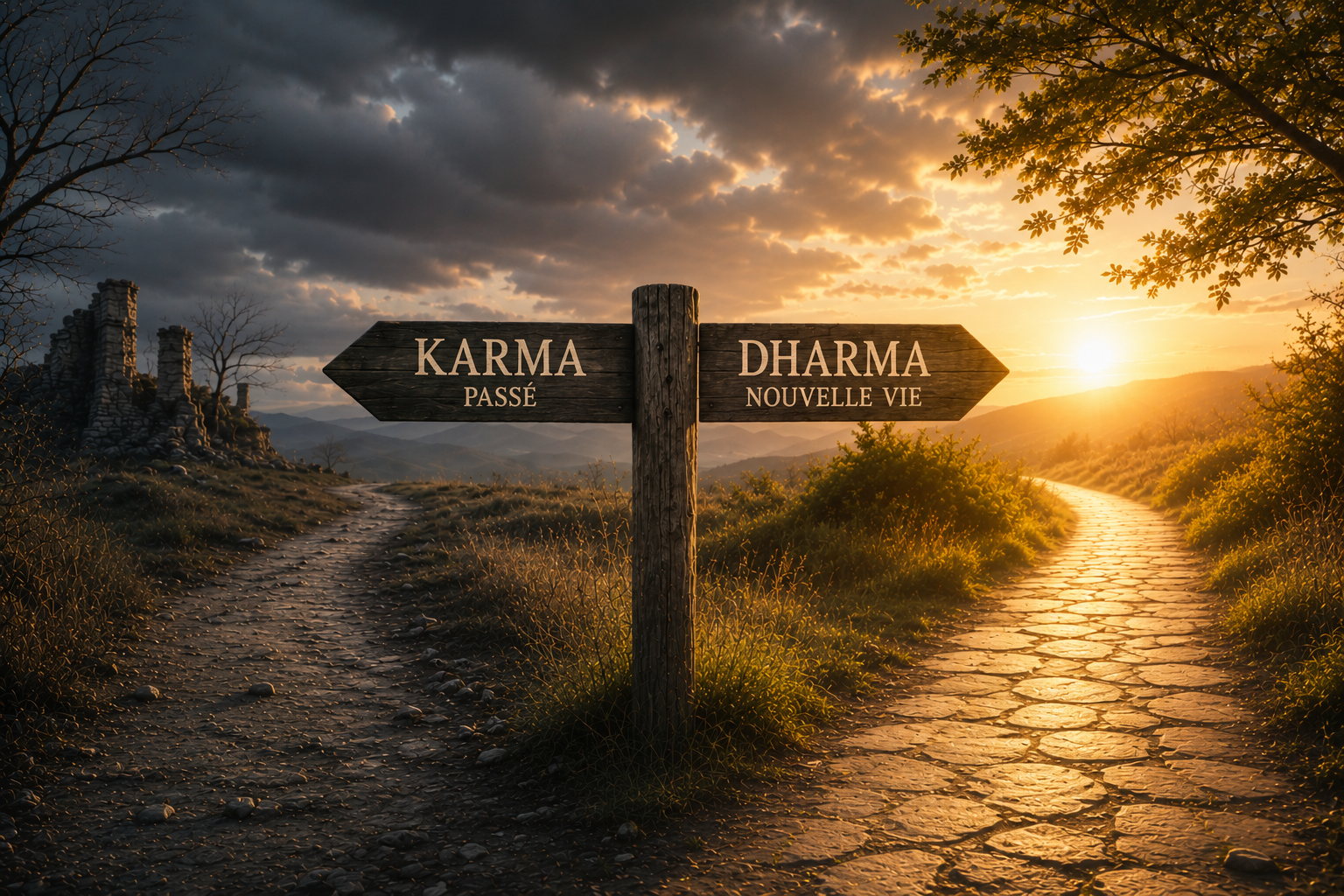
The Process Toward Dharma: Leaving the Past Behind, Overcoming the Fear of Change, and Finally Building Your Own Life. From Karma to Dharma: A Shift in Inner Direction
In my work, I often observe that the path of transformation is not defined by a single moment of awareness, but by a gradual shift in the way a person relates to their own life.
It is from this perspective that I distinguish two essential movements: karma and dharma.
Karma corresponds to everything that repeats itself throughout our lives. It manifests through old patterns, automatic reactions, invisible loyalties, as well as personal, family, and sometimes transgenerational memories. These are the dynamics that, often without our awareness, draw us back toward similar situations, familiar emotions, or life scenarios that seem to replay themselves over and over again.
Over time, these repetitions can create the feeling of moving in circles. Not because life itself is stagnant, but because certain inner patterns continue to shape our choices, perceptions, and reactions.
A person may eventually feel as though they are "going around in circles," reliving the same stories or encountering the same obstacles, even after changing relationships, careers, or environments. In reality, it is not the external world that repeats itself, but the inner way we experience it.
Karma is therefore not a life sentence.
It is a living memory.
An old way of interpreting the world, reacting, protecting ourselves, or adapting that continues to operate until it has been recognized.
Moving Beyond Karma and Entering Your Dharma Through My Approach
In my approach, moving beyond karma and entering one's dharma does not mean erasing the past or fighting against it.
Rather, it means understanding how personal, family, and transgenerational memories continue to influence our present-day choices, often without our realizing it.
The work I offer helps bring these invisible mechanisms into the light: repetitive relationship patterns, family loyalties, inherited fears, and deeply rooted conditioning that shapes the way we act and perceive the world.
Once these dynamics become visible, something naturally begins to change.
It becomes possible to stop reacting solely from old patterns and to begin making choices from a place that is more conscious, freer, and more aligned.
It is within this subtle shift that the passage from karma to dharma gradually unfolds.
Dharma does not belong to the logic of repetition.
It is not simply a return to oneself, a goal to achieve, or even a final destination.
Rather, it is a change of inner direction—sometimes subtle, yet profoundly transformative.
This movement begins when we no longer live exclusively through our fears, our conditioning, or the expectations of others.
It is not about erasing these influences.
It is about no longer allowing them to determine every decision, every choice, or every step forward.
From this perspective, dharma is not about becoming someone else.
It does not ask us to transform into an idealized version of ourselves.
Instead, it opens the possibility of living a life that has not yet been lived—a life no longer built solely upon the past, but also upon what is waiting to emerge.
This is often the moment when something becomes more noticeable.
A growing discomfort with what once felt familiar.
Choices that once seemed obvious no longer do.
Relationships no longer resonate in the same way.
Projects that once appeared logical lose their sense of certainty.
This is not a crisis.
It is an inner shift.
The passage from karma to dharma does not occur through sudden rupture, but through a gradual sense of misalignment with what is no longer right for us.
It is not a spectacular transformation.
More often than not, it is quiet—almost imperceptible at first.
And yet, it is precisely within that quietness that profound transformation takes place.
Little by little, something changes in the way decisions are made.
Choices become less confused, less burdened by inner tension.
Relationships evolve without forced effort.
Projects naturally find their rightful place.
Life gradually ceases to feel like a constant struggle and becomes a movement that is more coherent, more understandable, and more fluid.
Throughout this process, the goal is not to control life more intensely.
Quite the opposite.
It is to stop forcing life into directions dictated solely by the past.
It is often at this stage that old fears resurface.
Not to prevent change.
But to be seen differently.
The mind tries to return to familiar ground, seeking security, comparing, anticipating.
Yet something within us no longer responds in quite the same way.
This is where inner work becomes essential.
During the consultations I offer, we explore precisely these transitional spaces: invisible repetitions, family loyalties, personal memories, and unconscious conditioning that continue to influence present-day choices without being clearly recognized.
The goal is not to "fix" a life.
It is to understand what continues, at a deeper level, to shape it from the past.
This is also the central thread running through The Karma Trilogy, which explores personal, family, and relational dynamics, as well as Deconstruct Your Karma, which sheds light on the invisible conditioning that influences our beliefs, our decisions, and the way we inhabit the world.
Why Keep Certain Projects to Yourself?
There are moments during a process of transformation when silence becomes an essential ally.
Not every project needs to be shared immediately, explained, or validated by others.
When a project is still taking shape, it is especially vulnerable to other people's projections.
Their doubts, fears, and personal experiences can easily influence a direction that originally felt clear and deeply intuitive.
Keeping a project to yourself does not mean hiding it out of fear or distrust.
It means offering it a protected space, stable enough to develop without being weakened by premature opinions.
It is often within this silence that the most authentic projects take shape.
Not because they are isolated from the world, but because they have not yet been exposed to external interpretations.
The passage from karma to dharma is therefore not about becoming someone else.
It is about gradually ceasing to live solely through the repetitions of the past.
Perhaps it is the moment when life stops being a repetition...
...and finally begins to become a path.